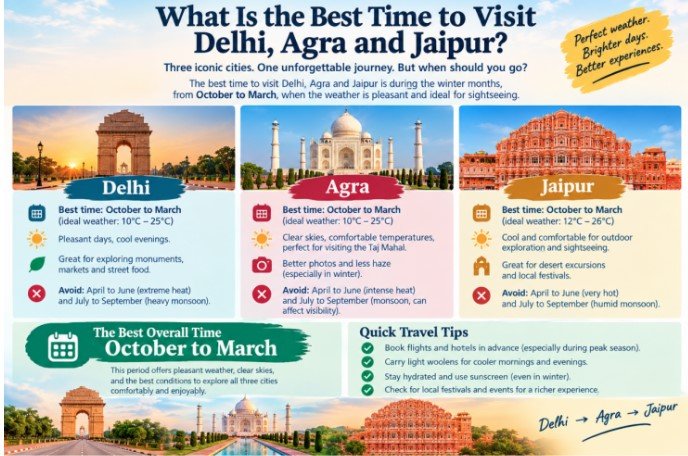
Ask ten people about the best time to visit Delhi, Agra and Jaipur and you’ll probably hear “winter” nine times. They aren’t wrong. But winter in northern India isn’t one thing. December in Delhi feels very different from late February in Jaipur, and the “off” months have charms that rarely make it into the brochures.
The Golden Triangle is one of those trips where timing quietly decides how much you enjoy it. You’ll spend long hours outdoors, climbing fort ramparts, walking through tomb gardens and haggling in bazaars, and the weather is a big part of whether those hours feel magical or exhausting. So let’s go through the year properly, season by season, and work out which window suits you.
A Quick Word on the Route
The Golden Triangle circuit links three cities that each shows you a different side of India. Delhi is the capital, a layered city where Mughal monuments, colonial boulevards and crowded old lanes sit side by side. Agra, about 230 kilometers south, is where the Taj Mahal stands. Jaipur, roughly 240 kilometers west of Agra, is the pink-washed capital of Rajasthan, full of palaces and hilltop forts. From Jaipur back to Delhi is around 280 kilometers.
Most of the sightseeing is open-air. Stone courtyards, marble platforms and sandstone walls soak up heat all day, and there’s very little shade at some of the big sites. That’s why the season matters more here than it would on, say, a museum-heavy city break.
The Short Answer
If you want a quick rule, travel between mid-October and mid-March. Days are mostly sunny and mild, usually somewhere between 15°C and 28°C, and you can comfortably spend a full day on your feet. The trade-off is that this is also the busiest stretch, so hotels, drivers and train seats get booked up early.
That said, plenty of travelers visit outside this window and have a wonderful time. It just takes a bit more planning.
Winter: The Classic Season (November to February)
Winter is when the Golden Triangle shows off. Skies are clear, the light is soft, and you can wander through Humayun’s Tomb or Amber Fort without feeling like you’re being slow-roasted.
Mornings, though, can be properly cold. In December and January, night temperatures in Delhi and Agra often drop to 5 or 6°C, and Jaipur isn’t far behind. If you’re picturing a warm, sunny India, pack a jacket and a scarf anyway. The afternoons warm up nicely, so layers are your friend.
Fog is the other thing to know about. From late December through January, thick morning fog regularly settles over the plains. It can delay trains, slow road traffic on the expressways, and sometimes hide the Taj Mahal entirely at sunrise. Plenty of people still love the misty, dreamlike look, but if a perfectly clear sunrise photo is your goal, leave some flexibility in your schedule.
Delhi’s air quality also tends to slip from November onward. It varies year to year, but travelers with asthma or breathing sensitivities should check daily readings and carry a decent mask. Agra and Jaipur are usually a little better.
Summer: Hot, Quiet and Cheaper (April to June)
Summers here are no joke. April is hot, and by May and June, afternoon temperatures in all three cities regularly climb past 40°C, sometimes touching 45°C. The air is dry, the sun is fierce, and the stone floors of forts can be uncomfortable even through shoes.
So why would anyone go? Because the crowds nearly vanish and the prices drop. Heritage hotels in Jaipur that are fully booked in January can offer generous discounts in June. If you can handle the heat, you’ll have places like the Taj Mahal grounds far quieter than most people ever see them.
If you do go, treat the day like a desert traveler would. Start sightseeing right when monuments open, usually around sunrise, head back to your air-conditioned hotel by late morning, and venture out again after four or five in the evening. Drink far more water than you think you need, wear light cotton, and don’t skip the hat and sunscreen.
Monsoon: Green, Humid and Underrated (July to September)
The monsoon arrives in the region around early July and lingers through September. It doesn’t rain constantly. Most days bring a few intense showers, with sunshine in between, and the landscape turns surprisingly green. The dust settles, the air feels fresher, and the heat of June finally loosens its grip.
It does come with humidity, and heavy downpours can flood streets or slow roads between cities. Some outdoor sights may feel soggy, and monkeys at certain monuments seem especially lively when it’s wet. But if you’re flexible and carry a light rain jacket, the monsoon can be a rewarding time. Tourists are few, prices are low, and there’s a certain calm over the cities that you won’t feel in peak season.
Jaipur also celebrates Teej during this time, a festival honoring the arrival of the rains, with swings, songs and processions that are a joy to stumble upon.
Going Month by Month
Sometimes it helps to zoom in a little.
October is the opening act. The monsoon has withdrawn, humidity eases, and evenings turn pleasant, although afternoons can still feel warm early in the month. It’s a smart choice if you want good weather without peak-season pricing. Dussehra and sometimes Diwali fall around now, so check the calendar.
November is arguably the sweet spot for weather. The air is dry, skies are bright, and temperatures feel comfortable from sunrise to sunset. The catch is that it’s popular, and Delhi’s air quality can worsen in the second half of the month.
December brings festive energy and chilly mornings. Christmas and New Year week are the busiest and priciest times of the whole year. If you travel then, book early and expect crowds at the big attractions.
January is cold at dawn and golden by noon. Republic Day on the 26th turns Delhi lively, though security closures affect some areas. The Jaipur Literature Festival, usually held in this month, fills the city with writers, readers and a creative buzz, and hotels sell out quickly.
February is the one many seasoned travelers quietly recommend. Fog has usually lifted, the days are warm without being harsh, and crowds start thinning out a bit compared with December and January.
March brings spring warmth and, in most years, Holi, the festival of colors. It’s exuberant fun if you’re ready to get covered in pigment, but some shops shut and streets get chaotic. By the end of the month, midday sun starts to bite.
April through June is the heat. July through September is the rain. We covered both above, and each has its own audience.
Which City Cares About Which Season?
The three cities are close enough that the weather is broadly similar, but there are small differences worth knowing.
Delhi is a walking city. Old Delhi’s lanes, the grounds of Humayun’s Tomb and Qutub Minar all reward unhurried exploration, so cooler months are ideal. If pollution concerns you, February or October may suit better than late autumn.
Agra revolves around the Taj Mahal, which looks different in every season. Winter mornings can be misty and atmospheric, while spring and early autumn often give clearer views with fewer people. One practical point: the Taj Mahal is closed on Fridays, so plan your Agra day accordingly. It’s also open for limited night viewing on a few evenings around the full moon, and tickets for that must be booked in advance.
Jaipur is where summer hurts the most, because the forts and palaces are built from heat-absorbing stone and perched on exposed hilltops. From November to February, climbing Amber Fort or wandering the City Palace is a pleasure. The old city bazaars also glow during Diwali, which is lovely if the dates line up.
Fitting It Into Limited Time
A lot of people only have a few days, and that’s fine. A 4 days Golden Triangle tour can cover the essentials: a first day in Delhi, a drive to Agra for the Taj Mahal and Agra Fort, a stop at Fatehpur Sikri on the way to Jaipur, then a morning at Amber Fort and the City Palace before heading back to Delhi.
It’s a full schedule, though. A big chunk of each day is spent on the road, so there’s very little buffer. In fog, extreme heat or heavy rain, a delay of a few hours can force you to drop something. That’s why a short itinerary works best in the clearer months, from late October to early March, when conditions are more predictable. Operators such as Star India Tours often point out that compact circuits are far more comfortable when the weather cooperates, and that’s good advice whether you book through someone or plan it yourself. If you can stretch to five or six days, the pace becomes much more relaxed.
Festivals That Can Make or Break Your Dates
Festivals add color to a trip, but they also change the practicalities.
Diwali, in October or November, turns cities into seas of lamps and fireworks. It’s beautiful, but some businesses close for a couple of days and flight and hotel prices climb.
Holi in March is joyful and messy. Wear clothes you’re happy to ruin, protect your phone and camera, and be aware that the main day itself can be rowdy in some areas.
Republic Day parade preparations in January can affect road access around central Delhi, and Jaipur’s literature festival brings crowds and higher hotel rates.
Teej in the monsoon is gentler and more local, a nice cultural bonus for off-season visitors.
If you’d rather avoid crowds, skip these dates. If you love atmosphere, build the trip around one.
Crowds and Costs, Honestly
Prices follow the weather. From November to February, rates for hotels, drivers and guides are at their highest, and the best heritage properties can sell out weeks ahead. October and March sit in a pleasant middle ground, with good weather and slightly softer prices. The summer and monsoon months offer the best bargains, sometimes with discounts of thirty percent or more.
Crowds are the other side of the coin. In peak season, the queue at the Taj Mahal can get long by mid-morning. Arriving at opening time, buying tickets online and visiting on a weekday all help. In the off-season, you may nearly have monuments to yourself.
Practical Tips That Work in Any Season
Book trains and cars early in winter, since popular routes fill up fast. Dress for the weather: layers in winter, breathable cotton in summer, a light rain jacket during the monsoon. Cover your shoulders and knees at religious sites. Keep one spare day in your plan if you can, because fog, rain and traffic have a way of eating into schedules. And try to start early. Early mornings are cooler, quieter and softer for photographs, whatever the month.
So, When Should You Go?
It depends on what you value. If comfortable weather matters most, aim for November, February or early March. If you want fewer crowds but still decent conditions, late October and mid-to-late March are strong choices. If your budget is tight and you can tolerate heat or rain, April through September offers real savings. And if festivals are your thing, choose Diwali, Holi or the Jaipur Literature Festival and plan around them.
No month is perfect, but most are good for something. Match the season to your priorities and the Golden Triangle will reward you.
Frequently Asked Questions
What is the best month to visit Delhi, Agra and Jaipur?
November and February are widely considered the best. Temperatures are comfortable, skies are mostly clear and sightseeing is easy. Book early, as both months are popular.
Is the Golden Triangle doable in four days?
Yes, though it’s a brisk pace. You can cover the main highlights of all three cities if you start early each day. It works best in cooler, clearer months, when weather won’t eat into your time.
Is it worth visiting the Golden Triangle in summer?
It can be, if you’re prepared. Temperatures often pass 40°C, so plan sightseeing for early morning and evening. In return, you’ll find smaller crowds and lower prices.
Should I avoid the monsoon season?
Not necessarily. The rains bring greener scenery and fewer tourists. Just expect humidity, sudden showers and the occasional travel delay.
When is the best time to photograph the Taj Mahal?
Clear days in October, November, February and March give crisp views. Winter mornings can add beautiful mist, but thick fog may hide the monument completely.
Is the Taj Mahal open every day?
No, it’s closed to regular visitors on Fridays. Plan your Agra day around this and book tickets online to skip long queues.
Final Thoughts
For most travelers, the best time to visit Delhi, Agra and Jaipur falls between October and March, when the weather lets you enjoy long days among forts, tombs and markets. But the shoulder months, the quiet summer and even the monsoon each have something to offer. Think about your comfort with heat and crowds, your budget and the experiences you’re after, then pick your dates. Whenever you go, the Golden Triangle has a way of staying with you long after you’ve flown home.
Route Fit
Match the guide to your timing, mobility, priorities and realistic daily pace.
Proof Check
Recheck current prices, entry rules, operating hours and transport schedules.
Backup Sticker
Keep one alternative for weather, closures, delays or sold-out inventory.
Pack the decision, not just the inspiration.
Use this guide as a planning framework, then confirm live conditions before paying, booking or changing your route.